Whetstone vs Pull-Through Sharpener — Which Should You Use?
A whetstone is the better sharpener for any kitchen knife you care about: it removes steel in a controlled way at the angle your blade actually needs, while a pull-through sharpener grinds at one fixed angle and can chip the harder, thinner edges of Japanese knives.
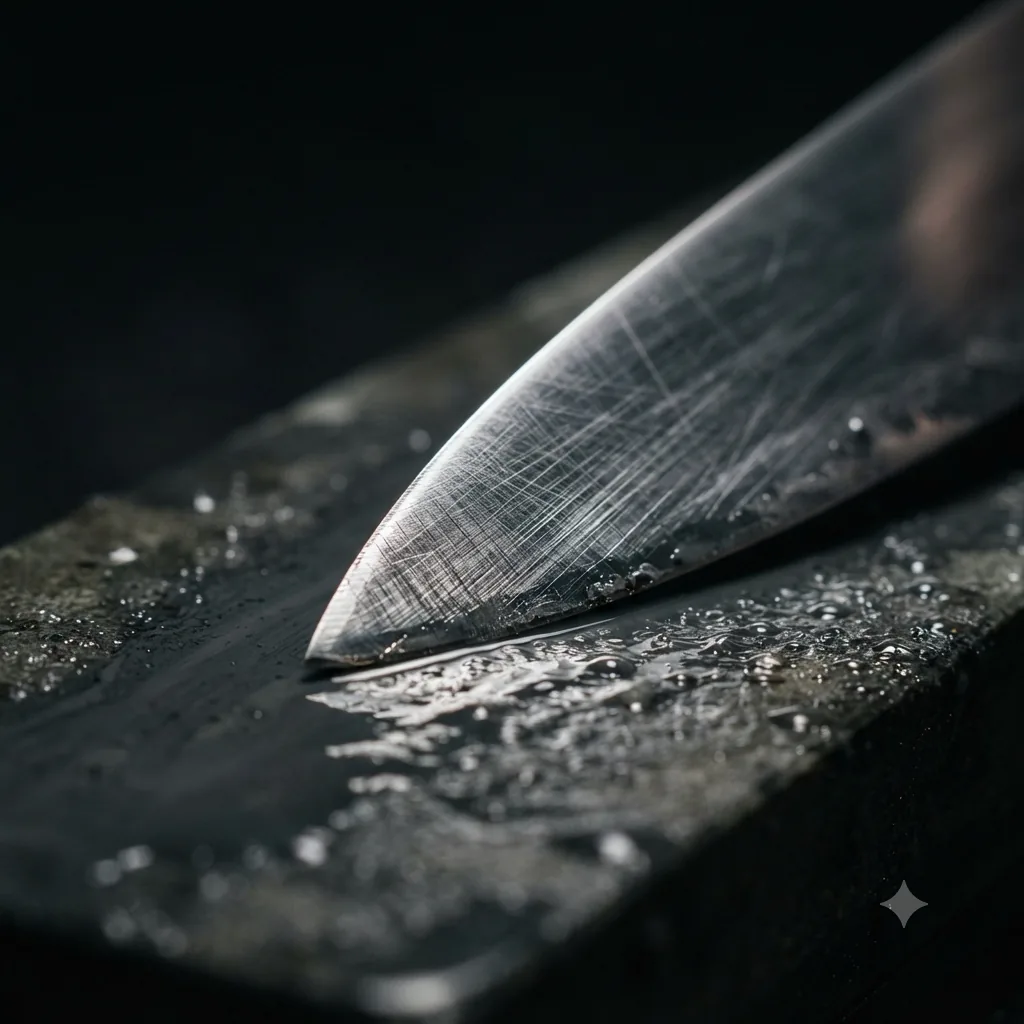
Why the whetstone wins
Sharpening is about matching the edge angle the knife was designed for. German knives (Wüsthof, Victorinox) run roughly 14-15 degrees per side on 56-58 HRC steel; Japanese knives (MAC, Tojiro) run roughly 10-15 degrees per side on 60-63 HRC steel. A whetstone lets you hold whichever angle your blade needs and control how much steel comes off. A pull-through sharpener has one preset angle and aggressive fixed abrasives — convenient, but it can't adapt to the knife.
The mismatch matters most on Japanese blades: harder steel takes a finer edge but is more brittle, and forcing it through a pull-through's notches at the wrong angle risks chipping. That's why our accessory guidance for Japanese knives specifies a proper whetstone, not a pull-through, to maintain the edge correctly.
Honing vs sharpening: two different jobs
Don't confuse the two. A honing steel realigns a rolled edge in a few strokes before each use and removes no meaningful steel — it's the habit that keeps a knife cutting like new between sharpenings. Actual sharpening removes steel to rebuild the edge and is only needed every 3-6 months for typical home use. If your knife stopped responding to honing, it's time for the stone.
Sharpening effort also depends on the steel. In our Knife Steel Numbers dataset, X50CrMoV15 rates easy to sharpen, VG-10 and MAC Original Steel rate moderate, and SG2/R2 powder steel rates hard — another reason a controllable whetstone beats a one-setting gadget as your knives get better.
Shop whetstone sets on Amazon →
Frequently Asked Questions
For any knife you care about, yes. A whetstone removes steel in a controlled way at an angle you set, so it can restore a true edge on both German knives (roughly 14-15 degrees per side) and Japanese knives (roughly 10-15 degrees per side). A pull-through sharpener grinds at one fixed angle with little control, which is a poor match for harder Japanese steel in particular — harder steel around 60 HRC and above needs a proper whetstone, not a pull-through, to maintain its edge correctly.
It can damage the edge. Japanese knives run harder, more brittle steel (typically 60-63 HRC versus 56-58 HRC for German knives) with thinner edge geometry. A pull-through's fixed carbide notches remove steel aggressively at an angle that usually doesn't match the factory edge, which can chip a hard, thin Japanese edge and shortens the life of the blade. Softer German stainless tolerates a pull-through better, but a whetstone still gives a cleaner result.
No. Honing with a honing steel only realigns a rolled edge — it removes no meaningful steel — and should be done every few uses. Sharpening actually removes steel to form a new edge, and only needs to happen every 3-6 months for a home cook, on a whetstone or via a professional sharpening service.
Every 3-6 months depending on use, with honing in between. German steel knives need sharpening less often but at a slightly wider angle; Japanese knives need it somewhat more often but reward you with a keener edge. Sharpening difficulty also varies by steel: X50CrMoV15 (Wüsthof, Victorinox) rates easy to sharpen, VG-10 and MAC's steel rate moderate, and very hard powder steels like SG2/R2 rate hard.
Related reading
Last updated: August 5, 2026.